
Kant From the Top Down [2]: Meet The Faculties
Carving up the mind
This post is part of a series. The first part can be found here.

In the first post, I introduced the project and discussed the methodology of Kant’s map of the mind: we take our experience as existing and true, and then consider what is necessary for that experience to be possible. I experience color, so I must have some faculty for color. I experience sound, so I must have some faculty of sound. I experience mustard, so I must have some faculty of mustard.
Evidently, the “faculty” convention can get a bit silly. But Kant wasn’t concerned with mustard (most of the time, at least): he wanted to know the most abstract, generalized, basic structures of our mind. Not our faculty to see color, or even our faculty to see, but our faculties necessary to have anything recognizable as “experience” at all: to have experience in space and across time, to have experience as an active agent, to have experience of objects. All of these fundamental facets of our experience, without which we could not recognize whatever was left as “experience,” require certain faculties in order to be possible. It was Kant’s mission to see exactly what was necessary and how.
The Faculties of the Mind
I will organize the following into relatively short sections, each dedicated to a specific faculty. Each faculty will receive an orienting description. Each description will begin with an orthodox Kantian systematic definition of the faculty, and then follow that with an attempt to explain that definition in plain language.
Without the jargon of the system, such orienting descriptions are the best we can do (and without such orientation, the jargon is incomprehensible). The goal is to begin with a rough idea of what in our experience we are picking out with these terms and then, as we learn more about the system, whittle down that block into something sharper. After the next post, in which we will tackle the jargon of the system, I will be more disciplined in my usage of terms. For now, I’m just doing my best.
Table of Contents
The Three Irreducible Faculties of the Mind
The faculty of cognition: thinking, representing, sensing
The feeling of pleasure and displeasure: responding to cognitions
The faculty of desire: planning, motivations, values
Intuition: space, time, imagination, appearances, ‘the given’
Sensibility: receptivity to ‘the given’, appearances
Outer intuition: space
Inner intuition: time
Imagination: associating and reproducing appearances
The higher faculties of cognition: thinking, concepts, ideas
Understanding: concepts, categories, the creation of rules organizing appearances
Judgment: application of concepts to particular instances and relating concepts to one another; the unification of representations
Reason
Theoretical/speculative reason: utilizes concepts through implicature, creates proofs
Practical reason: a.k.a. the will, uses maxims and imperatives to move between motivations/values/desires and action
The Three Irreducible Faculties of the Mind
In his third and final Critique, Kant produces the following table:1
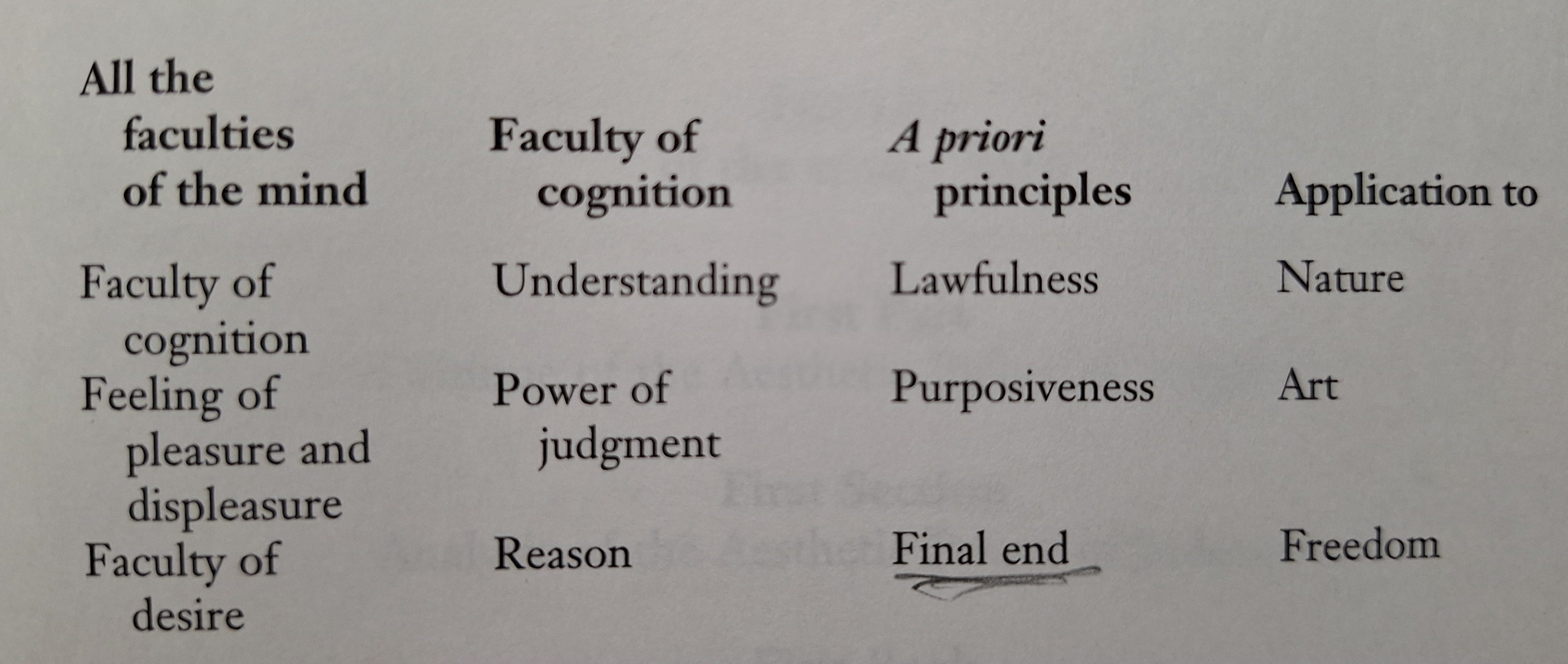
The table will hopefully make sense before the end of this series.
Kant believed all the faculties of our mind could fall into one of three buckets: the faculty of cognition, the faculty of pleasure and displeasure, and the faculty of desire. These three faculties together compose our experience.
Each of Kant’s three critiques focused on one of these three irreducible faculties and attempted to demonstrate the validity of some “higher” use of each of them. But that is for later. Right now, let’s just get some definitions straight.
The Faculty of Cognition
The faculty of cognition is the faculty by which we grasp objects and organize our own consciousness.
Cognition, for Kant, includes more than the narrower colloquial definition of ‘cognition’ (i.e. concentrated, directed thinking, often thinking with words) but less than the broader colloquial definition of ‘cognition’ (i.e. everything that goes on in our minds). For Kant, cognition is the domain of knowledge about the world. Knowledge, here, is the application of our concepts to the things we come into contact with in the world. The faculty of cognition includes both the faculties by which we construct concepts and also the faculties by which we come into contact with things.
Much of Kant’s focus (and therefore ours) is on the subfaculties of cognition and how they interact with the three irreducible faculties of the mind. This makes sense because he is interested in understanding the nature of our knowledge and, especially, the possibility of us having knowledge of our three irreducible faculties themselves. (Can we cognize about the faculties of our own mind? Can we learn anything from doing so? These are the questions that activate Kant.)
The Faculty of Pleasure and Displeasure
The faculty of pleasure and displeasure is the faculty by which a part of experience becomes the motivation for its continuation or cessation.
The name of this irreducible faculty is the most intuitive of the three, but its explanation is the least, so let me explain the explanation. Ignoring the internal experience of pleasure or displeasure, the function of these feelings is to react to a part of experience and create a subjective motivation with regard to it. When we find something pleasing (or any of the various emotions grouped around pleasing), we want to continue that experience or achieve the objective of that experience. Similarly for displeasure.
So, pleasure and displeasure are the mechanism by which an object (brought to us by cognition) becomes a motivation. Which brings us to:
The Faculty of Desire
The faculty of desire is the faculty by which an internal representation becomes the cause of its realization (i.e. the cause of us making it real).
This faculty is the worst-named of the three, and its explanation is the weirdest, if not the worst. This faculty is the faculty by which an internal ground/motivation/desire is translated into action, which has as its purpose making that internal ground/motivation/desire real—making it so it is the case externally. Therefore, the faculty takes something we create in our heads (that which we want to be true, that which motivates us/is pleasing to us) and makes that thing in our heads the cause of that thing becoming real. This faculty is using the internal experience provided by the faculty of pleasure and displeasure and combining it with the knowledge of the faculty of cognition to bring about the case toward which we are motivated.
I would call this faculty the faculty of value or motivation, rather than desire. Desire, to me, is too closely tied to emotion to give the whole breadth of what this faculty is doing in its normal course. Kant also lodges morality in the faculty of desire, which I believe further makes “desire” a less conducive name than value or motivation. I will, going forth, use the term “faculty of desire” so as to keep my terminology in line with the proper authorities, but I will suggest that when you read “faculty of desire,” you also consider it as the “faculty of value” or “faculty of motivation.”
Intuition
Intuition is the manner by which a mode of knowledge immediately relates to objects.
A seemingly important fact about experience is that we bump into things which are not us—and, furthermore, are not our thoughts (colloquially construed). When we “bump into” things, we relate to objects immediately. There is no step in between me seeing an object and me relating to the object as being seen. Contrast this with a concept, which relates to objects only through an act of application.
Intuition, here, does not mean instinct or implicit knowledge—it is the immediate ‘that’-ness of the world. Mediated relationships with objects require steps of inference: I must realize that ‘that’ is a cat, perhaps on a mat. The concept ‘cat’ must be applied. The piece of experience which I conceptually term a cat required no inference.
One way to think about the lack of mediation is that one cannot be ‘wrong’ about an intuition. The intuition is just what is. Even if the intuition is a hallucination, that hallucination is still what appears to you—determining it a hallucination is a conceptual act which leads you to believe that the hallucination will or won’t have certain effects (for instance, even if I try to drink that water, I won’t actually be less thirsty in an hour). The intuited hallucination is still there, you just believe different things about it.
Kant doesn’t quite use the language of “faculties of intuition[.]” He generally reserves the term “faculty” for higher cognitive faculties. However, I think it is helpful to think of sensibility and perhaps even inner and outer intuition as faculties. Even if the following are not faculties of intuition as in subfaculties subsumable to a higher whole, they are still faculties with regard to intuitions.
One way to think of these are as a sort of “lower cognitive faculties” which relate to receiving, forming, and reproducing intuitions. The higher cognitive faculties will organize, apply, and implicate intuitions, but for now, we need to figure out what is necessary to be able to retain and use this intuitions in the first place.
Sensibility
Sensibility is the capacity to receive the given.
For us to have intuitions, there must be some way for us to come into contact with something that is not us.2 Sensibility is not necessarily all the senses we have, but merely the fact that we have senses at all—that there is a path between our mind and something else.
Outer Intuition
We experience the world spatially.
All of our external intuitions are spatial in nature. This faculty represents our ability to format sensation in a spatial manner. Without space, we would need an entirely new, currently-inconceivable way to organize our intuitions of the external world. Whatever senses we use to interact with the outside world, we receive their information spatially and cannot cognize a non-spatial method of doing so.
Inner Intuition
We experience ourselves temporally.
This definition is easier to get tripped up on than the one for outer intuition. Kant believes that time is our intuition of our selves. We usually think of time as a connection to the past and future, but this connection could not be an intuition: our connection to the future is mediated by our attempts at prediction and our connection to the past is mediated by our ability to recall previous intuitions (see, below, Imagination). Neither the past nor the future exists in the sense that intuitions are just there.
Time as a form of intuition is how we relate different internal representations/experiences. We organize the fact that one thing (ourselves) has experienced multiple things by relating them to each other across time—X occurred and not-X occurred because X occurred before not-X. In this way, time allows us to construct a sense of a self: without external change, there is no way to note that there is some thing (the self) which connects different experiences separated in time. This has gotten a little into the prove-y territory, but it has been in service of trying to express why time is our intuition of inner sense.
Imagination
Imagination is the capacity to reproduce and associate intuitions.
Without imagination, experience would be a mere succession of outer intuitions. There would be no way to fully think because we could not recall intuitions and connect them to one another. We could never build patterns to understand or connect parts of our experience as signifying similar things—I could not connect this cat with that cat (or, indeed, even this cat with this-cat-in-the-future) because I could never recall my prior intuition of the previous cat.
We can imagine things actively, not merely receptively. It also sits in an awkward place with these other faculties, not being an input to intuition but rather a necessary ground for the higher cognitive faculties to act on the intuitions. Only because imagination can recall and associate intuitions can our higher cognitive faculties package these intuitions into logical boxes we deem concepts and relate those concepts to one another and back to the world. The imagination mediates between sensibility—the raw perceptive capacity of experience—and our higher cognitive faculties, which require bunches of perceptions on which to do their work.
Speaking of. . .
The Higher Cognitive Faculties
These are the all-stars, the big-shots, of Kantian philosophy. We love talking about these guys. The understanding? Obsessed. Judgment? Yessir. Reason? Excuse me, did you mean the love of my life and sum vocation of humanity?
These are the faculties of creating, applying, and using concepts. However, just because these cognitive faculties primarily have to do with what we colloquially consider “thinking,” that doesn’t mean they are entirely conscious. As a general note: faculties often have active and receptive3 capacities. Outer intuition, for one, has the automatic quality of organizing sensation. We don’t actively plug our sensation into the outer intuition machine and tinker with it until it spits out spatial intuitions. That just happens. However, outer intuition is also how Kant thinks we do geometry. We can create spatial intuitions actively in our minds to try to solve problems. We will return to this issue later.
Kant analogizes the higher cognitive faculties to the structure of a syllogism. A classical syllogism reads: major premise, minor premise, conclusion. The major premise is a categorical claim: traditionally, “all men are mortal.” The minor premise is an application to a specific instance: traditionally, “Socrates is a man.” The conclusion uses the application to connect the instance with a new category: “Socrates is mortal.” The major premise is the work of the understanding (claim connecting classes of things), the minor premise is the work of judgment (application of a class to a particular instance), and the conclusion is the work of reason (implying new knowledge from a set of propositions). Let’s take these one at a time.
The Understanding
The understanding is the faculty of rules.
Through the understanding we can make general relations between classes: cats are mammals; all dogs bark; oxygen is an element; friction causes heat; things with [various cat-like features] are cats; things with [various dog-like features] are dogs. The understanding takes a whole bunch of representations (i.e. general bits and bobs of experience) and bundles them up under a single thing—a concept. The understanding allows us to cook up these rules as we try to organize our experience. We will get more specific later about the kinds of rules that the understanding can create, but for now, remember that the understanding is how we generalize.
The Power of Judgment
The power of judgment is the faculty of determining whether something does or does not fall under a rule, i.e. of application.
I’ll be honest: “the power of judgment” is a terrible name. It is a terrible name because Kant also talks a lot about “judgments,” his general term for propositions like the ones I gave above (“all dogs bark; . . .”). By his third Critique, which focuses on the power of judgment, he has this mostly figured out, but the first Critique is a mess in this regard. This led Schopenhauer to criticize Kant as inconsistent in his third Critique, alleging “after it had been incessantly repeated in the Critique of Pure Reason that the understanding is the ability to judge, and after the forms of its judgements are made the foundation–stone of all philosophy, a quite peculiar power of judgement now appears which is entirely different from that ability.”
Here is Schopenhauer’s problem: a judgment is a general term for conceptual knowledge, but also a specific power of applying concepts to intuitions. Whereas the understanding would say “things with [various cat-like features] are cats,” the power of judgment would say “that is a cat,” while pointing at what it thought was a cat. Now, we might then say “why do you think that is a cat?” and we would then explain, using the understanding, “things with [various cat-like features] are cats” and then using the power of judgment again “that has [various cat-like features], including pointy ears, as you can see right here.”
In this light, “the power of judgment” is actually a pretty good name for this. When we talk about “judgment” colloquially, we are talking about an ability to assess a holistic situation and determine its relevant qualities. Judgment can be guided, and practiced, but not taught. Since judgment is the faculty of determining whether something falls under a rule, it can’t really be given a rule, because you still need judgment to determine whether the bounds of that new rule. Judgment works with examples and practice—it is a fundamentally inductive faculty.
We will return to the problem of whether the power of judgment is truly distinct from the understanding, but for now I think you can get a rough idea of how they differ: judgment is how we bring the products of the understanding to bear on a particular thing.
Reason
Reason is the power of implication.
This may sound minor. It is not. Take our previous example. The power of judgment says “that is a cat” and is then questioned “why do you think that is a cat?” The understanding might say, “things with [various cat-like features] are cats” and the power of judgment can tag back in to say “that has [various cat-like features], including pointy ears, as you can see right here.” Without reason, the conversation ends there. All we would know is that “that” has cat-like features. Only reason can pipe in to say “because it has [various cat-like features], it is therefore a cat.” Only reason can use the concepts.
Some time ago, my mom and grandfather were talking about our family. Paraphrasing, the conversation went something like this:
Grandfather: . . .and this is Aunt Mildred, my cousin. An incredibly bright woman. She was the first in our family to go to college.
Mom: Wow. She went to college when, then? That must have been a long time ago.
My mom knew that Aunt Mildred was my grandfather’s cousin. She also knew that my grandfather is old and that he went to college when he was young. Now, time for some implicature: since Mildred was first to go to college, that must have been at least before my grandfather went to college. She termed this period of time “a long time ago.”
It wouldn’t really make sense for this to be a product of the understanding, as we are working on a particular instance and not so much forming a new rule as we are connecting rules and applications in a chain of implication. Mildred first in college → college before grandfather → grandfather old → grandfather college long time ago → Mildred college long time ago. These sorts of analyses can go infinitely granular (what does “first” mean in relation to when my grandfather when to college?), but the point is that while the understanding generalizes and the power of judgment applies, only reason can organize.
Reason as I have explained it above is speculative reason—reason also includes the faculty of practical reason. Practical reason is the will. The will determines actions through maxims, which we can roughly articulate as “when X, I will do Y to make Z happen.” Practical reason makes sense as a subfaculty of reason because maxims are fundamentally implicatory: I have the circumstances and my desired end goal, and from that I imply my course of action. Unlike the understanding, I am not taking a whole bunch of data points and concocting a rule for all of them; unlike judgment I am not merely saying that this circumstance falls under a certain class of circumstances. Rather, I am accounting for my circumstances and goals, and reasoning my way towards what actions they imply.
If this was confusing and unhelpful, I have good news and bad news: the bad news is much remains to be said, and many more pieces of the puzzle remain to contextualize the first batch I laid out above. The good news is the same as the bad news. Next time: jargon.
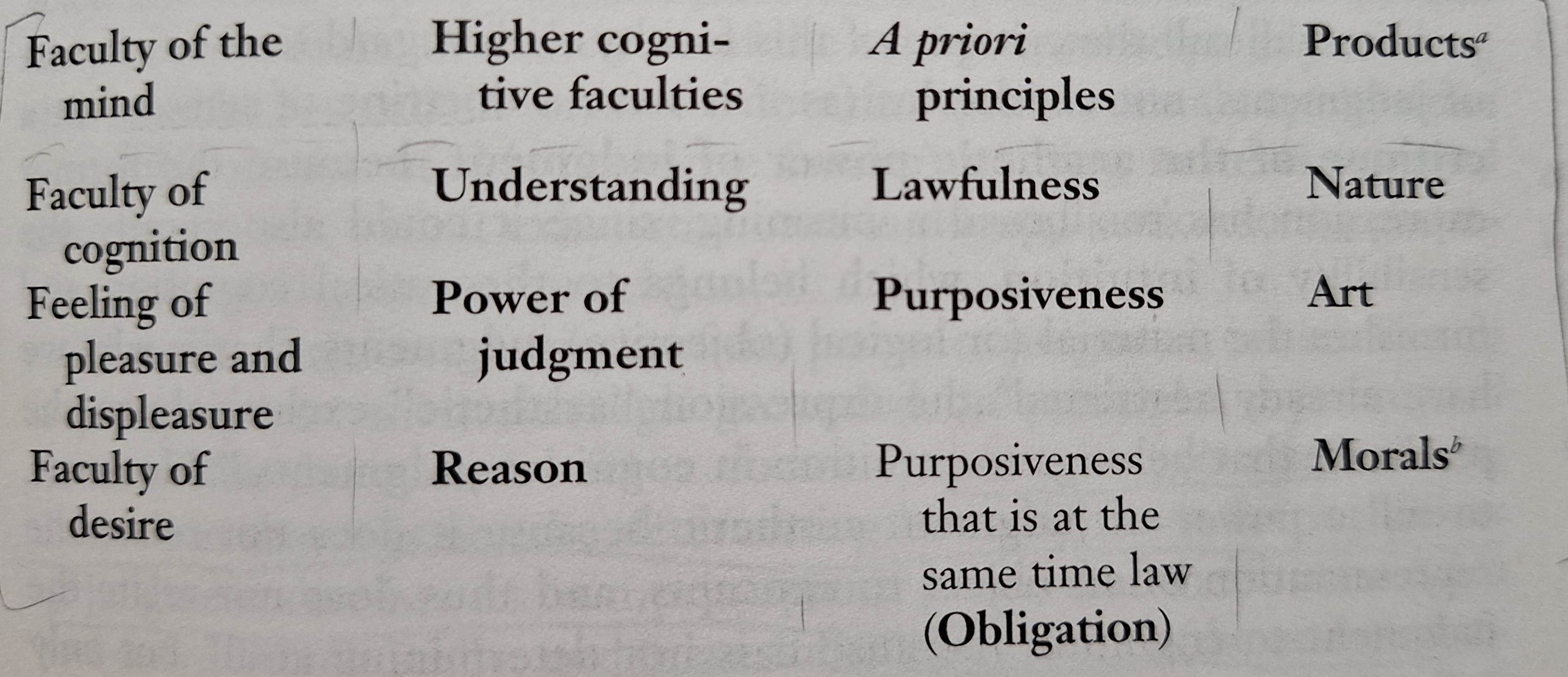
In an earlier draft introduction, Kant produces this table, which I actually like more in some ways:
This is actually a contentious philosophical assertion, but we will deal with proving it later. For now, just take it that we really do need something outside of ourselves to give content to our intuitions.
Alternatively, “conscious and subconscious” or “intentional and automatic.”